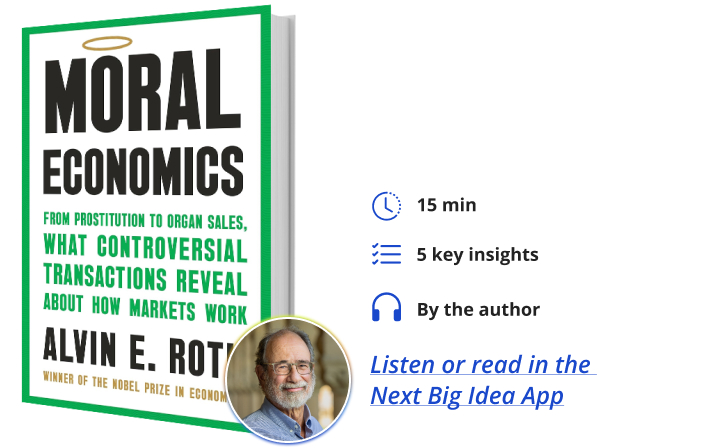
I post market design related news and items about repugnant markets. See my Stanford profile. I have a forthcoming book : Moral Economics The subtitle is "From Prostitution to Organ Sales, What Controversial Transactions Reveal About How Markets Work."
"To really understand the nuts and bolts of economics, look to the black market. Alvin E. Roth is Craig and Susan McCaw Professor of Economics at Stanford University and the George Gund Professor of Economics and Business Administration Emeritus at Harvard University. He was awarded the Nobel Prize in Economics in 2012. He joins host Krys Boyd to discuss his work on organ donation which led him to study what he called “repugnant transactions” like sex and drugs and why he feels banning them completely doesn’t always have the effect we think it does. His book is “Moral Economics: From Prostitution to Organ Sales, What Controversial Transactions Reveal About How Markets Work.”
Transcript (also at the above link)
Here's a very contemporary Texas question:
"Krys Boyd [00:25:48] I’m really curious, Alvin, about whether making things illegal has much of an effect on things. I live in Texas, where recreational marijuana is against the law. I can tell you just anecdotally that it appears to not stop very many people. You pose this interesting question about why the laws work pretty well to keep people from committing murder for hire, but not so well at all from buying and selling illegal drugs. "
"Kidneys, surrogacy, prostitution, gambling, price gouging, assisted dying: some transactions make people recoil, even when all parties consent. Cato’s Ryan Bourne talks with Nobel Prize-winning economist Alvin Roth about his new book, Moral Economics, what makes markets “repugnant,” what economists can add to moral debates, and why banning exchange rarely makes scarcity, exploitation, or hard trade-offs disappear."
Below, Alvin Roth shares five key insights from his new book, Moral Economics: From Prostitution to Organ Sales, What Controversial Transactions Reveal About How Markets Work.
Alvin is the Craig and Susan McCaw Professor of Economics at Stanford
University and the George Gund Professor of Economics and Business
Administration Emeritus at Harvard University. A pioneering expert in
the field of market design, he was awarded the Nobel Prize in Economics
in 2012. He is also a member of the National Academy of Sciences and
past president of the American Economic Association.
What’s the big idea?
There’s an old joke about economics and sociology that says
economists try to understand the choices people make, and sociologists
try to understand why people don’t really have any choices. Alvin looks at how societies try to decide whether to allow some choices and ban others.
There are lots of morally contested markets and transactions that
some people would like to engage in, but others think shouldn’t be
allowed. Often, the objections are stated in terms of moral or religious
reasons. And the transactions that the opponents seek to ban don’t harm
them personally—they might not even know the transactions had occurred
unless someone tells them.
For example, same-sex marriage is a morally contested transaction:
two people want to marry each other, and some other people don’t think
same-sex marriages should be allowed—even though you can’t tell if
someone is married unless they tell you, for instance, by wearing a
wedding ring. For centuries, marriage was regarded as inherently
heterosexual. But, after considerable controversy, the U.S. and many
other countries have legalized same-sex unions.
This isn’t a unique situation. Lots of controversial markets are
connected to reproduction. There have been bans at different times and
places on contraceptives, in vitro fertilization, abortion, and
surrogacy. That is, there have been laws enshrining opposing views about
whether a woman should be able to prevent becoming pregnant during sex (by buying contraception), should be able to initiate a pregnancy without sexual intercourse (via IVF), or be able to terminate
a pregnancy via abortion, not to mention being a surrogate or having a
surrogate bear a baby. In the U.S., all those things have been through
the courts multiple times and with different results.
Notice that reliable contraception and IVF involve modern disputes
about modern technologies. Before reliable contraception, sex between a
man and a woman often resulted in pregnancy, and before assisted
reproductive technology, like IVF, sex was the only avenue to
pregnancy. Many traditional laws and norms that attempted to keep sex
within the bounds of marriage between a man and a woman were attempts to
ensure that babies would be born into families. But if pregnancy
becomes a choice, and if there are other ways to have a child than
intercourse between a man and a woman, then the door opens to more
expansive views about who can have sex with whom, and who can start a
family. So, while expanding marriage to include same-sex couples doesn’t
depend on modern technology, we can see that the changes in
reproductive technology may have moved the needle on what kinds of
marriages and related transactions receive social support.
Of course, bans on extra-marital sex, prostitution, or abortion never
succeeded in making those things disappear, even though they raised
barriers.
2. Bans on markets need social support to work well.
Some bans work well while others give rise to active black markets.
For example, why is it so easy to buy drugs, but so hard to hire a
hitman? U.S. laws aren’t so different for drug dealers and hitmen: if we
catch them, we send them to prison for a long time. Yet our prisons are
filled with drug dealers, and there have been years in which more than
100,000 people died from opioid overdoses. But murder for hire is so
rare that it doesn’t even make it into the national crime statistics,
and homicides from any cause are vastly fewer than drug overdose deaths.
At least some of the difference has to do with how people think about
drugs and murder. If I told you I was looking to buy some heroin, you
would be surprised, but you wouldn’t call the police (and if you did,
they would tell you that they were busy with more pressing calls). But
if I told you I was looking to hire a killer, you might very well call
the police, and when you did, they would encourage you to tell me that I
might find an available hitman at a certain bar, where I would find
myself trying to hire an undercover detective. To put it another way,
there are neighborhoods where drugs are readily available, and the
neighbors look away, but not so many neighborhoods where killers are the
norm, in part reflecting that the social norm against drugs is much
more porous than against murder.
“At least some of the difference has to do with how people think about drugs and murder.”
I don’t know how we should best make progress in dealing with the
markets for addictive, lethal drugs. Not only are we losing the “War on
Drugs,” but it won’t even accept our surrender: experiments with
decriminalizing drug use have shown the potential to make cities less
livable. We’re going to need to experiment, to find better ways to
proceed.
It’s worth noticing that we’ve learned to live with legal markets for
tobacco and alcohol, even though each of those causes more deaths than
are due to drug overdoses. And we’re wrestling with some other kinds of
addiction, such as gambling (particularly on your phone, during a game).
The drug epidemic teaches us that well-intentioned policies can fail.
By and large no one approves of heroin, but we haven’t succeeded in
vanquishing it any more than we succeeded in making alcohol disappear
during Prohibition.
3. Moral intuitions aren’t enough by themselves.
We need to gather and pay attention to evidence about the
consequences of particular policies. This is hard when moral intuitions
collide, partly because much moral argumentation rests on weak or no
evidence. But we can’t afford to judge our policies just by their
intentions. We have to at least look at their consequences, too.
Nevertheless, moral intuitions are important and consequential, so we
need to understand them better. There are some things that many moral
intuitions have in common. For example, concern about the possible
exploitation of vulnerable people is often an issue.
4. Sometimes adding money to a transaction arouses repugnance.
For example, paying in cash is what turns sex into prostitution.
Often, the objection to introducing money into transactions is that it
might be an undue influence that could coerce the poor into
transactions that they (or we) would prefer not to take part in. But
that’s over-broad: many people work for financial pay at jobs they
wouldn’t otherwise do. And many goods and services that we need wouldn’t
be available if they couldn’t be paid for.
“Many people work for financial pay at jobs they wouldn’t otherwise do.”
Pharmaceuticals made from blood plasma are a good example. Many
countries ban payments to plasma donors and try (almost always
unsuccessfully) to generate as much as they need of the large amounts of
plasma required to treat many diseases from unpaid donors. How do they
make up for the shortfall? Fortunately, you can buy plasma and
plasma-derived medicines from the U.S. We’re the Saudi Arabia of blood
plasma, exporting tens of billions of dollars of plasma products each
year, collected largely from plasma donors who are paid.
5. Religion remains important in many controversies.
It plays a large role in the growth of legal medical aid in dying, in the U.S. and elsewhere.
Overall, in pursuing moral economics, we have to keep in mind the maxim that ought implies can, and the things we feel morally obligated to do, whether by supporting them or banning them, have to be things that we can
do. To understand those limits, we need evidence, including
experimentation, to figure out how to proceed when we’re worried by all
our options.
"despite the severity of the allegations — an affair that raised serious blackmail risks, attending openly partisan events, and lying to investigators when caught — the Eleventh Circuit and the Judicial Conference both concealed the judge’s identity. They even adjusted the very minor sanction to allow the judge “to word the letters of apology vaguely so as to ensure that a letter could not be ‘used against [the Subject Judge] in some way.’”
...
"The Eleventh Circuit thought it had been so clever in anonymizing its report. The reports don’t include a name or a district, and refer only to “Subject Judge” throughout. The reports even assiduously avoid identifying the judge by gender, proving that even conservative judges can figure out how pronouns work with minimal effort. And yet the reports failed to obscure a number of details that made working out the judge’s identity possible.
...
Handing the reports into two different AI models and turning on all the “deep research” modes, the bots churned for several minutes comparing the reports to publicly available information. Both models delivered lengthy reports reaching the same conclusion. So how did these models do it?
...
"the models instantly filtered out the entire state of Florida. The official reports are littered with references, in varying contexts, to the office of “District Attorney.” Florida uses “State Attorneys” for its local prosecutors. After that, the bots noted that the sanction barred the judge from ever serving as chief judge of their district — meaning the judge was not senior status and not currently the chief judge. The report indicates that investigators spoke with clerks dating back to 2020, disqualifying anyone elevated after that. Discussing the judge attending a DA’s primary victory party, the bot pointed out that the judge had claimed to know the candidate based on their time at the office, narrowing the scope to judges with state prosecutorial experience who overlapped with a sitting DA who won a primary. And had martinis at the victory party. The AI models decided that matched with Atlanta’s Fani Willis. [as the DA]
Once it narrowed the list down, the bot also searched the dockets of possible judges to match the claim in the reports that the high-ranking law enforcement officer did not materialize into a conflict because no cases involving that police department showed up on the judge’s docket.
For good measure, the bot went ahead and took a guess at the officer’s identity too.
In about 10 minutes of work, the AI unraveled all the work these judges put in to keep this confidential. With nothing but a couple of published court documents and the open web. In the time someone might brew a cup of coffee, the most basic possible workflow defeated the Eleventh Circuit’s entire anonymization strategy."
"On June 9, 2025, after the [NY State] Assembly approved the bill, Ms. Netherland was in the State Senate chamber, watching the aye votes mount, and seeing it pass.Gov. Kathy Hochul signedan amended version in February; it is scheduled to take effect Aug. 5.
“A breakthrough moment,” said Kevin Díaz, president of Compassion & Choices, which has spearheaded the long campaign for such laws. After almost 30 years — Oregon’s law, the first in the country, was enacted in 1997 — the addition of two populous states means that almost a third of Americans will live in one where medical aid in dying is legally available. “It shows that there’s broad support for this model,” Mr. Díaz said.
Polls consistently back that claim. APew Research Center surveylast spring found that almost two-thirds of respondents didn’t consider the practice “morally wrong,” either because they thought it was acceptable or not a moral issue."
As the title suggests, the statement focuses on removing financial disincentives for organ donation.
But I'm struck by the last item on the list:
"Additional Steps "In advocating for the elimination of disincentives to living donation, AST will examine, in parallel, the legal,ethical, and practical considerations involved in a pilot study of financial incentives for living organ donation."
"A Nobel Prize-winning economist makes the case that our moral objections to controversial markets are getting people killed.
Alvin Roth won the Nobel Prize in Economics for figuring out how to build markets that work. Now he's turned his attention to the markets we refuse to build, and why that refusal has consequences nobody wants to talk about.
In this episode, Mary and Al dig into what he calls "repugnant transactions" — the deals that some people want to make and others think shouldn't be allowed. They get into why banning organ sales creates black markets where donors get operated on in apartments, why the same logic that ended Prohibition applies to the war on drugs, how surrogacy bans in Europe are turning babies into stateless people, and why it's easy to buy heroin but nearly impossible to hire a hit man.
Al's argument isn't that everything should be for sale. It's that if you care about outcomes more than intentions, you have to confront what your bans are actually doing.
Subscribe for new episodes every week.
Chapters:
00:00 Friendship Isn't A Market
00:32 Meet Nobel Economist Al Roth
01:02 What Makes a Market "Repugnant"?
02:58 Should We Pay People for Kidneys?
08:31 Why Drugs Thrive But Hit Men Don't
15:58 Surrogacy, Politics, and Unintended Consequences
21:45 Why Prohibition Keeps Failing
25:19 Markets, Morality, and Reality
28:19 The Rise of Prediction Markets
34:30 What Money Can't Buy"
"Nobel Prize-winning economist Alvin E. Roth discusses the moral limits of markets, how bans create black markets, and why harm reduction often works better than prohibition."
He talks with Nick Gillespie about why some voluntary transactions
provoke moral outrage even when no one is being directly harmed. Roth
explains why black markets often emerge when governments try to ban
activities with persistent demand, why both markets and prohibitions
require social support to function, and how unintended consequences can
make moralistic policies backfire. They discuss the war on drugs,
prostitution, surrogacy, same-sex marriage, price gouging, and why Iran
remains the only country in the world with a legal market for kidney
donors.
They also explore Roth's work designing kidney exchange
networks and school choice systems, how digital technology and private
transactions make certain bans harder to enforce, and why harm reduction
may work better than prohibition in areas ranging from drug policy to
sex work."
"A Swedish minister has accused France of mounting “an attack on the Swedish way of living” with its ban on nicotine pouches, setting aflame a single market fight over how governments should regulate smoke-free alternatives to tobacco.
"France last month implemented one of Europe’s strictest bans on the pouches, a flavoured sachet that users tuck under their lip to release nicotine.
"France’s decree goes beyond other EU countries’ prohibitions by banning not just sales but import, possession and use of the pouches. A Swede carrying a tin of pouches legally bought at home could face French penalties of up to five years in prison and a €375,000 fine.
“It is as if we would prohibit French baguettes or French wine in Sweden,” Swedish trade minister Benjamin Dousa told the FT. “It is absurd.”
Speaking with the great sociologist Mark Granovetter gave me the opportunity to tell the joke "“Economists study how people make choices; sociologists study why people don’t have choices," since Moral Economics is about the controversial markets over which society struggles with which choices should be allowed and which should be banned.
Stanford's Center for the History of Capitalism sponsored the conversation, and here it is on YouTube, but it's just a podcast, there's audio of our conversation, but no video.
Here's the short version, from the issue's overview in World in Brief.
"Alvin Roth investigates repugnant markets
"Would you like to buy a kidney? How about heroin? Or sex? Don’t worry: you haven’t wandered down the wrong alley—these and other morally questionable transactions are the subject of a new book by Alvin Roth, a Nobel-prize winning economist. Published in Britain on Thursday, “Moral Economics” looks at the murky world of “repugnant transactions”: deals in which buyers and sellers happily transact, but which onlookers would rather ban on moral grounds.
"For Mr Roth, moral economics is about trade-offs. Are the harms of allowing an activity greater than those of disallowing it? Policy, he argues, should weigh both. Two principles emerge. First, bans never fully work: motivated buyers and sellers find workarounds. Second, prohibition generally reduces the size of the market; it would be cheaper and easier to buy heroin if it was legal. It might also be safer. That leaves Mr Roth asking whether the restrictions or the market cause more harm. Here, too, the answer is that it depends."
###########
And here's a link to the longer review, from the Free Exchange column. That column is unsigned, but others on the web have attributed it to Gavin Jackson, who did interview me about the book. Here is the resulting review:
My review of the review is that it missed some of the nuances in my book, but many aspects of the big picture came through clearly:
"The picture that emerges from the book is of a deeply moral person, who believes in bodily autonomy, in not subordinating individual lives to a collective and in not accepting unnecessary deaths to spare some people from feeling squeamish."
Neale Mahoney interviews me on Econ to go (with a transcript of our half hour conversation).
"Neale Mahoney: Markets are often treated like natural objects, things that simply exist. But economist Al Roth sees them differently. To him, markets are human inventions, systems we design, shape, and sometimes struggle to agree on. Because when money and morality collide, things can get complicated. Who should be allowed to buy and sell? What should they be allowed to transact? and what happens when people want to trade things that others find morally unacceptable.
Alvin Roth: I think that one of the things we need to do is experiment on what we're morally obliged to do and reflect on it in connection with what we're actually able to do.
Neale Mahoney: I'm Neale Mahoney, Economist and Director of the Stanford Institute for Economic Policy Research. On this episode of "Econ To Go," I catch up with Stanford Economist and Nobel Laureate Al Roth over coffee on campus. We talk about what he calls moral economics, the study of markets where society struggles to agree on what should be bought and sold. From kidney exchange to commercial surrogacy, from prostitution laws to the surprising economics of matchmaking, Al shows us that markets don't just allocate goods. They also reflect our values. You've said that markets and marketplaces are human artifacts. They are not just features of the natural environment. Why is that a good starting place when we think about the study of economics?
Alvin Roth: Well, for a long time, economists sort of thought that markets were things that we just had to take as given. You know, we speak of economists thinking of people as price takers, but in fact, they also thought of us as market takers. There are these markets. But of course, markets are human artifacts. To a great extent they're collective human artifacts, but marketplaces are often artifacts of individual companies or designers, or small groups of participants who modify the marketplace to fit their needs over time, just in the way that Uber is a marketplace designed by the company Uber. But I think there's a good analogy, which is that languages are also human artifacts, and they're collective human artifacts. You and I can speak to each other in English because we both learned English in a conventional way, but there are lots of words in our English that weren't in the language 100 years ago, words like computer and internet and AI. So, we're constantly modifying the language to better suit our needs."
"Key messages of the report are: • The global market for nicotine pouches is growing rapidly. • Nicotine pouches can be highly addictive; furthermore, some have high concentrations of nicotine, and some increase the speed and intensity of nicotine delivery (e.g. “pearls technology”). • Labelling of nicotine content is not standardized and can be confusing and misleading. • Some nicotine pouch packaging mimics popular candy products and contain high nicotine levels. If they are ingested by children, they can pose a lethal risk. • Nicotine pouches often contain various youth-appealing flavours (e.g. sweet, fruity, mint/menthol), such as Cherry Punch and Frosted Apple, and candy-like flavours (e.g. “bubble gum” and “gummy bears”), which are particularly attractive to children. The flavours of numerous alcoholic drinks are also used, marketed as “After dark”. • Nicotine pouches often promote high-intensity nicotine and flavours with slogans such as “nicotine like never before” and visual depictions of the user experiencing a cooling effect.
• Nicotine pouches are aggressively marketed and promoted to young people. – They are heavily advertised on youth-frequented social and digital media platforms, including through influencers. – They are frequently promoted with youthful themes, including fun times with friends, romance and sports. – They are often promoted for “discreet” or stealthy use, making it difficult to detect by parents or teachers, and as a way of breaking the rules. – Manufacturers of nicotine pouches commonly sponsor youth-oriented events, where nicotine pouches and branded merchandise are distributed by attractive, young “brand ambassadors”. • Nicotine pouch advertisements often use the tobacco industry’s “playbook” for marketing conventional tobacco products, such as cigarettes, including: – “lifestyle marketing” and “identity marketing”, the message sometimes portraying how a consumer wishes to be perceived by others; – depictions of nicotine pouches as “modern” and “high-tech”; and – portrayal of nicotine pouches as boosting energy when the user is tired and helping the user to relax when stressed. Marketers call this “elasticity of meaning”, depicting the product as something that works for everyone in any situation. • Nicotine pouch manufacturers market and associate their brands with holidays (e.g. Christmas) and cultural symbols (e.g. patriotism) to evoke happy times and celebrations. • Messaging in nicotine pouch advertisements can appear contradictory, expressing opposing views; however, this is carefully crafted and tailored to different target groups, such as: – co-marketing of a nicotine pouch brand with promotion of a flagship cigarette (or other tobacco) brand, while also marketing of nicotine pouches and conveying anti-cigarette messaging (e.g. “goodbye smoke smell”). • Nicotine pouches are marketed with unsubstantiated claims that they aid smoking cessation and/or in ways that undermine quit attempts. • Nicotine pouches are often promoted as a product for “Anytime, Anywhere”, with images of places in which smoking is not allowed. This marketing tactic can encourage dual use, hinder cessation attempts and undermine regulations prohibiting smoking or use of other tobacco and related products in public places. • There is insufficient national action, whereby nicotine pouches commonly fall through regulatory gaps and thus either un- or lightly regulated. • WHO calls for a comprehensive approach to tobacco control, covering the full spectrum of tobacco and related products, including nicotine pouches, and closing regulatory loopholes. "
I spoke about economics with Keynes (Soumaya) in the FT:
Nobel laureate Al Roth and the economics of organ sales "The economist Alvin Roth been talking about kidneys since at least 2003, noting time and again that kidneys are in short supply, waiting lists are growing longer, and people are dying as a result.
" Soumaya Keynes So we always start this show with a silly question. So, on a scale of one to 10, how relaxed are you about marketisation? So 10, you’re extremely relaxed about having transactions in literally anything, and maybe five is the average person.
You can watch the AEI book event (and hear me read the first paragraph of the book, and chat about it for about 20 minutes) followed by discussion by Alex Tabarrok, Judd Kessler and Nick Gillespie, and Q&A, all introduced an moderated by Sally Satel.
Here’s a picture taken by Peter Jaworski
And here we are on Youtube (this was originally a live stream):
"With organ shortages claiming thousands of lives annually, this session explores whether carefully designed market mechanisms can increase donation rates while maintaining ethical standards and preventing exploitation.
Panelists: - Alexander Capron, USC Law/Bioethics https://gould.usc.edu/faculty/profile/alexander-capron/
- (TBC) Gabriel Danovitch, UCLA David Geffen School of Medicine, https://www.uclahealth.org/providers/gabriel-danovitch
"Roth gave a talk in 2017 at the Organ Donation Congress in Geneva about one such chain that started in 2015. A woman from the Philippines, known in the literature as FW, was willing to give up one of her kidneys to save the life of her husband, FM. The two flew to the US, where FM received a kidney from an altruistic donor in Georgia, and FW’s kidney was transplanted into a man in Minnesota. A friend of the Minnesota man, who had been willing to give up one of her kidneys to save his life, instead gave one to a man in Washington, whose father-in-law gave a kidney to a woman in Georgia, and so on. By the end of the year there had been 11 successful transplants, and the chain was still continuing.
" After his talk, Roth was confronted by a Spanish doctor who was deeply concerned about the potentially problematic implications of the economic inequality between the Philippines and the US. Roth pointed out that without the transplant, the patient would surely have died. Replied the Spanish nephrologist: “He should be dead!” Spain’s National Transplant Organization later denounced Roth as an organ trafficker.
"Roth tells this story in his most recent book, Moral Economics (Basic Venture, May 12), which, at least in part, is an attempt to apply the empiricism of economics to domains that are often resistant to such analysis. The opposition to the 2015 kidney chain, for instance, comes from nephrologists who have no problem with chains but who draw the line at international chains, or at least chains linking poor and rich countries."
######
Much of the objection to cross-border kidney exchange appears to be fading, some of it was based on the idea that countries should be self-sufficient in transplants.
This morning the Washington Post published my op-ed online (which is scheduled to appear in the print edition on Sunday). 800 words is hardly enough to explain why I think what I do...I could write a whole book about that.
"A federal appeals court issued a ruling on Friday temporarily halting the ability of abortion providers to prescribe pills using telemedicine and send them to patients by mail, blocking what has become a major avenue for women seeking abortions in recent years.
"The order comes in a case in which the state of Louisiana is suing the Food and Drug Administration, seeking to sharply curtail access to the abortion pill mifepristone. In the order, a panel of the U.S. Court of Appeals for the Fifth Circuit granted Louisiana’s request for a temporary stay of the F.D.A.’s decision several years ago to remove a requirement that patients see a medical provider in person before the pills could be prescribed.
"The court order, citing Louisiana’s claims that making pills available by mail has allowed patients there to access the medication despite the state’s near-total abortion ban, said that “Louisiana has shown that it is irreparably harmed without a stay.”
"In April, a Federal District Court in Louisiana had declined to pause the availability of pills by mail, instead saying that the proceedings should be delayed until the F.D.A. completes a safety review of mifepristone that is underway and is expected to take until late this year."
#######
And here's the NYT on the appeal by pharma companies to the Supreme Court:
"Administration officials recently told The New York Times that the review would not be finished until the end of this year, a time frame that would fall after the midterm elections.
"The mifepristone case puts the Trump administration in a politically tricky position, given that many of President Trump’s supporters oppose abortion."
A column (on unemployment) in the Sunday Times by it's economics editor David Smith, ends with a brief review of Moral Economics, as a postscript:
PS "A lot of economics books cross my desk, but a new one, by the Nobel prize-winning economist Alvin Roth, grabbed my attention. Called Moral Economics: What Controversial Transactions Reveal About How Markets Work, to be published soon by Basic Books, it is not a title designed to send it racing off the shelves.
However, it starts in an arresting way with a story I had not heard before of another celebrated Nobel prize-winning behavioural economist, Daniel Kahneman, known to many for his bestselling book Thinking, Fast and Slow. Two years ago, he celebrated his 90th birthday with family in Paris before flying to Zurich and ending his life in an assisted suicide clinic. “Danny,” Roth recalls, “was still in relatively good health, but he wanted to avoid the prospect of a long, disabling decline.”
...
It is a fascinating and very different economics book, from which I may bring you more as I find it."
In the Netherlands, not only is it legal to receive medical aid in dying (MAID), but a growing number of MAID patients are able to successfully achieve their desire to become deceased organ donors.
"Abstract: The number of organ donation after euthanasia (ODE) procedures in the Netherlands has grown substantially, yet their contribution to the lung-donor pool remains unclear. There is no clinical consensus on how these potential ODE lung-donors should be assessed. We aimed to describe the total contribution of ODE to the lung-donor pool in the Netherlands and describe the assessment of potential ODE lung-donors. We collected data from all ODE procedures performed between 2012-2024 in the Netherlands. We assessed the number of ODE-lungs offered, rejected, accepted, and transplanted, comparing characteristics of discarded and transplanted lungs. Of 1166 lung-donor, 664(60%) were DCD donors of which 154(23%) were ODE lung-donors. The total proportion of donor lungs from ODE lung-donors acceptable to offer for lung transplantation was 117 of which 104 (89%) were transplanted. Evaluation prior to donation was highly variable, with medical history and chest CT most affecting acceptance decisions. Short-term outcomes were excellent, with 1-year survival of 84%. Our findings indicate that ODE lung donors are increasingly important in the Netherlands, with high acceptance rates, despite highly variable evaluation methods. Standardizing the assessment of potential ODE lung donors could further improve acceptance rates and enhance the contribution of ODE to the lung-donor pool."




 Posts
Posts

